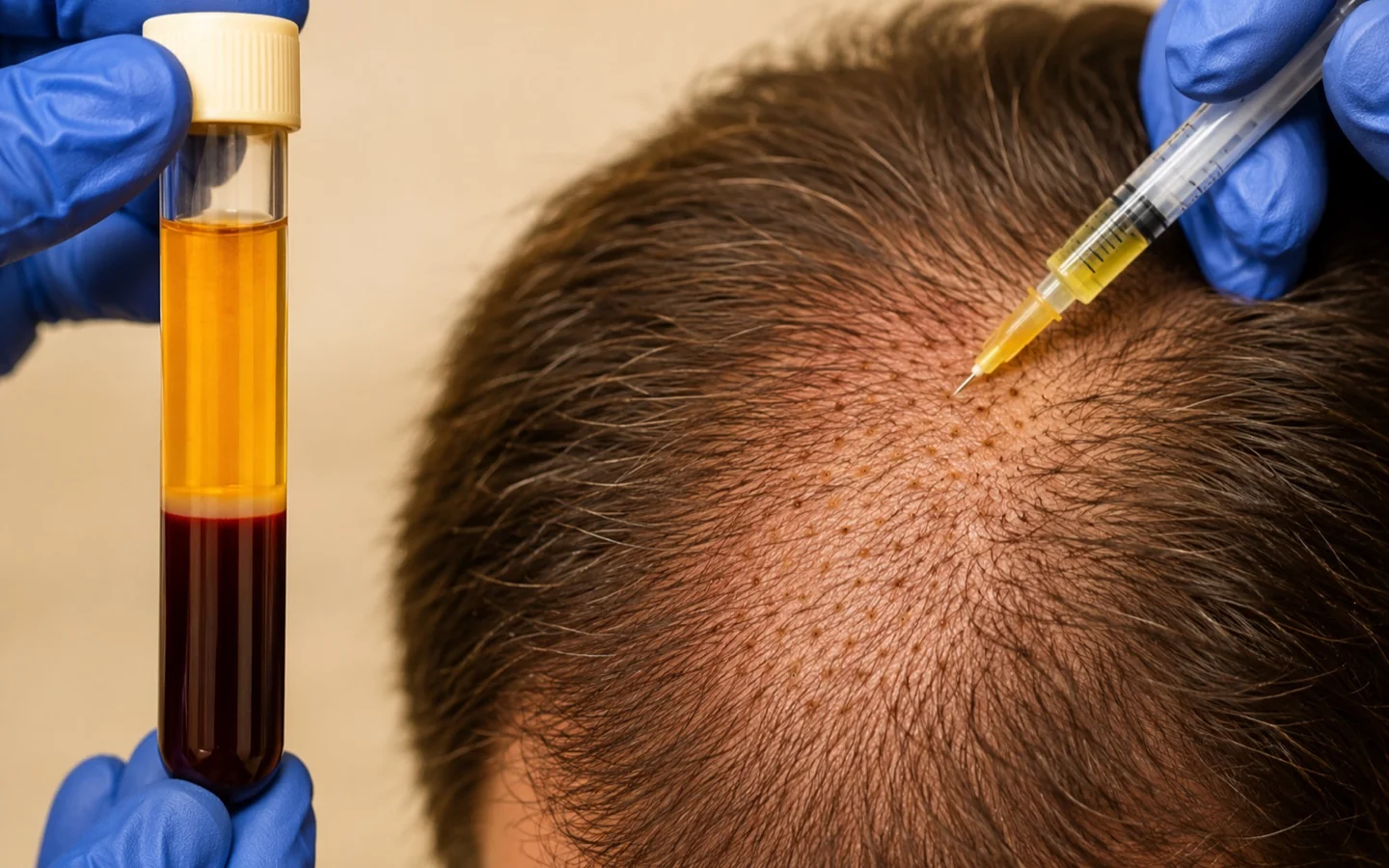
Dr. Vézina reviews your hair loss pattern, medical history, and existing therapy.
Not everyone needs surgery.
Some need science.
Evidence-based, non-surgical hair loss care — physician-directed in Montréal and Toronto, administered by an experienced nurse under Dr. Vézina's protocols.
The Revio approach to
non-surgical care.
A hair transplant is the right answer for some patients. For others — particularly those at the start of hair loss, or those protecting a recent transplant — it is not yet the answer, or not the answer at all. Revio offers the medical and biologic treatments that come before, alongside, or instead of surgery.
At many clinics, PRP and medical hair loss treatments are administered by technicians or aestheticians, with little or no physician oversight. At Revio, the model is different: PRP injections are administered by an experienced nurse following Dr. Vézina's proprietary protocols, with the medical assessment, treatment plan, and ongoing monitoring performed by Dr. Vézina herself. Medical therapy is prescribed and monitored by Dr. Vézina personally. The clinical standards do not change because the procedure is less invasive.
This matters because:
- PRP technique varies. The volume injected, the depth, the pattern, the spacing of treatments — each affects outcome.
- Medical therapy interacts with your specific physiology. Generic prescriptions and dosing miss this.
- Hair loss is rarely one thing. Hormones, scalp inflammation, nutrition, stress, genetics — the physician's eye is what tells these apart.
What is
PRP?
PRP — Platelet-Rich Plasma — is a treatment that uses growth factors from your own blood to stimulate hair follicle activity.
The process:
- A small volume of your blood is drawn — similar to a routine blood test.
- The sample is processed in a centrifuge to concentrate the platelets and the growth factors they contain.
- An experienced nurse injects the concentrate into your scalp at the precise locations and depths recommended by our physician.
The growth factors in PRP can support the function of existing hair follicles — particularly those that are still alive but underperforming. For over a decade, this restorative technique has been applied across multiple medical fields, including orthopedic surgery, dermatology, and dentistry.
What PRP can —
and cannot — do.
What PRP does well:
- ✓Strengthens existing follicles that have weakened.
- ✓Improves hair shaft thickness and density in patients with early-to-moderate hair loss.
- ✓Supports recovery and maturation after a hair transplant.
What PRP cannot do:
- It cannot create new follicles where none remain.
- It is not a substitute for a hair transplant in advanced hair loss.
- Its effect is not permanent — maintenance treatments are required to sustain results.
We tell you this directly, because the industry too often does not.
When PRP
makes sense.
Three clinical applications — before a transplant, after one, or alongside medical therapy.
- Early-stage hair loss
For patients beginning to notice thinning — at the crown, temples, or part line — PRP can strengthen existing follicles before they are lost. The earlier the intervention, the more there is to preserve.
- Post-transplant maintenance
After a hair transplant, the surrounding non-transplanted hair continues to follow its natural aging pattern. PRP helps slow that progression and protect the surgical result. For many of our transplant patients, PRP becomes a long-term part of their plan.
- Combined with medical therapy
PRP works best when paired with appropriate medical therapy (such as finasteride or minoxidil, when clinically indicated). Dr. Vézina builds the combination to your physiology.
The PRP protocol
at Revio.
How treatment unfolds, from first assessment to maintenance.
Four treatments, typically spaced four to six weeks apart. This series establishes the foundation.
One treatment every six to twelve months, depending on your response.
Photographs and follicle metrics are tracked at each visit, so progress is measured — not assumed.
Each session takes approximately one hour. Most patients return to work the same day.
Other medical
treatments.
Two medications have strong clinical evidence in the treatment of pattern hair loss: finasteride and minoxidil. Both have a role in many of our patients' plans. Both also have side effects, contraindications, and limits that are too often glossed over in the industry.
At Revio:
- We do not prescribe medication without an evaluation.
- We do not present medication as a guaranteed result.
- We explain the mechanism, the realistic timeline, the side-effect profile, and the alternatives.
- We monitor your response over time and adjust.
If medication is not right for you, we will tell you. If it is, we will help you use it well.
PRP bundles for
transplant patients.
A hair transplant restores what was lost. But it does not stop the natural aging of the hair around it. For patients who have invested in a transplant, we offer dedicated PRP bundles — designed to sustain the result and preserve the surrounding hair over the years that follow.
Bundles include a planned schedule of maintenance treatments, photographic monitoring, and adjusted medical therapy as appropriate.
Revio PRP vs.
medi-spa PRP.
| Feature | Revio | Medi-spa / aesthetician administration |
|---|---|---|
| Administered by | An experienced nurse, following Dr. Vézina's proprietary protocols. | Technician, nurse, or aesthetician — often without physician oversight. |
| Pre-treatment evaluation | Full physician assessment of hair loss pattern, medical history, and contraindications. | Often skipped or limited to intake form. |
| Protocol design | Volume, depth, and spacing tailored to your case. | Standardized template. |
| Monitoring | Photographs and follicle metrics tracked across sessions. | Limited or none. |
| Combined therapy | PRP integrated with medical therapy when appropriate. | PRP offered in isolation. |
| Honesty about limits | We tell you when PRP will not help you. | Marketed as universally effective. |
Frequently asked
questions.
- Is PRP painful?
The injections involve mild discomfort. We use a specific semi-automated device with fine needles to minimize it — no “gun” or handheld syringe. Most patients describe the sensation as brief and tolerable.
- How quickly does it work?
PRP works gradually. Most patients begin to see changes after the second or third treatment in the initial series — typically around three to four months from the first session.
- How long do results last?
PRP requires maintenance. Without continued treatments, the effect diminishes over six to twelve months.
- Can PRP replace a hair transplant?
No. PRP supports existing follicles. It cannot create new ones. In advanced hair loss, surgery is the only way to restore density where it has been lost.
- Is it safe?
PRP uses your own blood instead of a foreign substance. The principal risks are bruising, mild swelling and/or redness, and the rare possibility of infection — all of which Dr. Vézina manages carefully.
- Who performs the treatment at Revio?
Every PRP injection is administered by an experienced nurse using Dr. Vézina's proprietary protocols. No technicians or aestheticians.
Start with an honest answer.
A consultation begins with the question of what is actually happening with your hair — and what, if anything, will help. We will not sell you a treatment that does not fit your situation.